
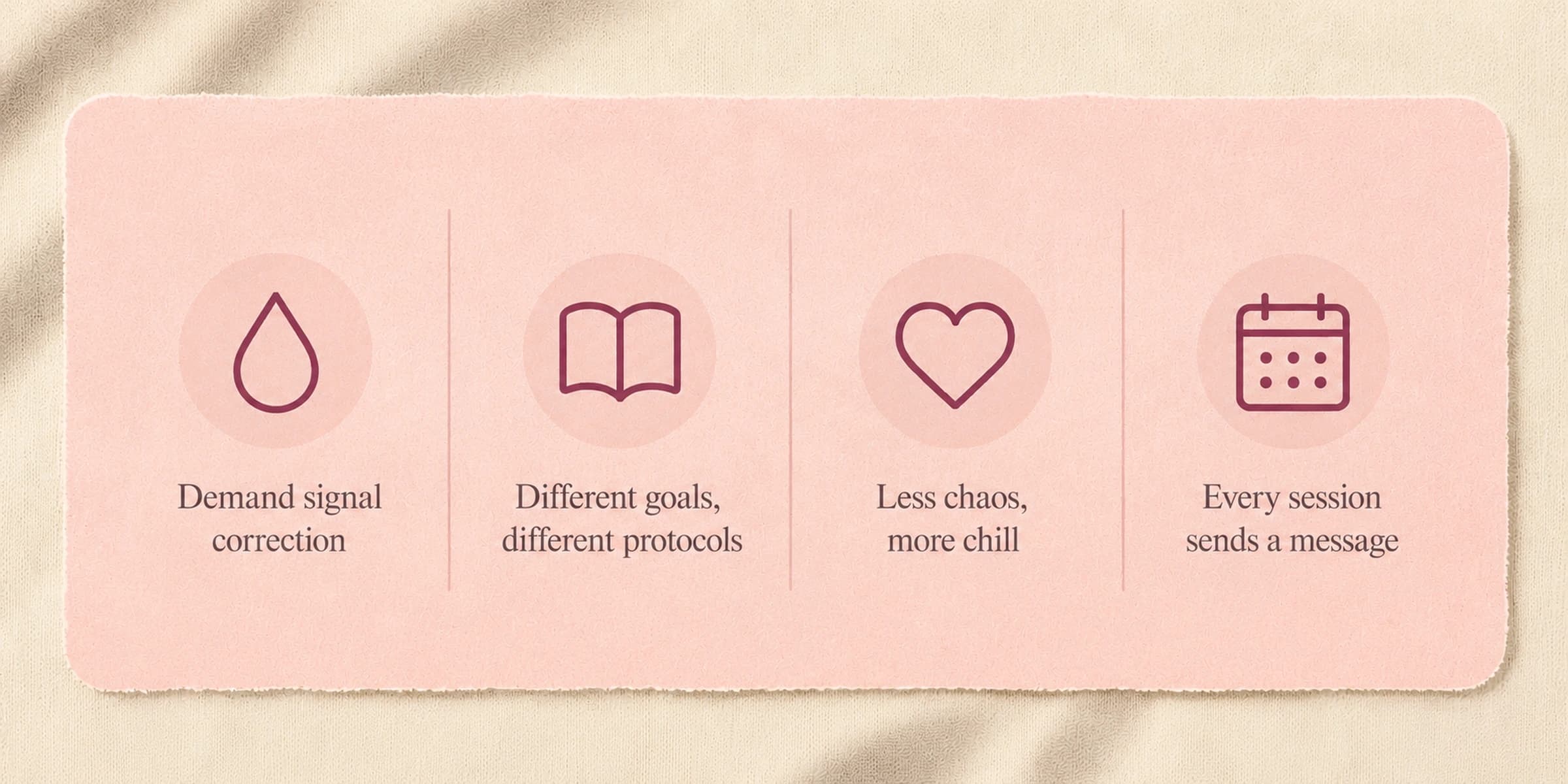
Your pumping output varies from session to session — and understanding the difference between correcting a demand signal and simply extracting milk could be the missing piece in your supply journey.
It's late. You've pumped again. The output looks the same as yesterday, or lower, and you're starting to wonder if you're doing something wrong — or if your body has simply decided it's done.
Before you spiral: you might not have a supply problem. You might have a protocol problem (better, isn't it?).
There's a distinction that almost nobody talks about, and it sits at the center of most pumping frustration. Two sessions can look identical from the outside — same pump, same duration, same time of day — and be doing completely different things: one is training your body, the other is harvesting what's already there.
These are not the same act.
The signal your body is actually listening to
Milk supply runs on a supply-and-demand feedback loop. Your body doesn't produce milk in advance and store it indefinitely — it produces based on what it believes is being asked of it. That belief is shaped by how often milk is removed, how completely (are you actually emptying?), and how consistently. This is the logic behind demand signal correction.
When you pump with the goal of changing your supply — building it, rebuilding it after a dip, recovering after illness — you're not just removing milk, you're sending a message. Frequency matters, completeness of emptying matters, timing matters. A session that yields less than you hoped might still be doing exactly what it needs to do, because the signal was sent regardless of the volume in the bottle.
This is also why pumping without intent can quietly work against you. Inconsistent sessions, or sessions that stop before you're fully empty, can gradually signal down — telling your body it needs to produce less. Not dramatically, but slowly, and by the time you notice, it reads like a supply problem when it's actually a signaling problem.
Extraction sessions are different — and they belong at a different stage
Once your supply is where you need it to be, the goal shifts. You're no longer training the system — you're working with it. Extraction sessions are about efficiency: removing milk from a supply that's already established. The hormonal feedback loop is still in play, but the primary purpose is harvest, not recalibration.
⚠️ This is the mode most people assume they're always in, which is part of why so many supply journeys stall.
Treating a demand-correction phase like an extraction phase is one of the most common invisible mistakes in pumping. The sessions feel the same, the effort is the same, but the intent — and the outcome — are completely different.
Three goals. Three different protocols.
Most pumping journeys have one of three objectives at any given moment:
Increase supply. This is a demand-signal-correction phase. The protocol here is about frequency and consistency above all else — more signals, sent reliably, over a sustained period. Output per session is not the metric to watch; the trend over days is.
Maintain supply. This sits between the two modes. You're sustaining a signal that's already calibrated. Consistency still matters, but the pressure is lower. A missed session here or there won't unravel things the way it might during a building phase.
Wean. This is intentional signal reduction — the mirror image of the building phase. The goal is to gradually tell your body to produce less, which means spacing sessions out deliberately and reducing complete emptying over time. Done without a protocol, weaning can get uncomfortable fast. Done with one, it's manageable.
The protocol you follow should match the goal you have. Pumping mechanically, without knowing which phase you're in, means you might be working hard in entirely the wrong direction.
What your pumping output actually means at 3 a.m.
If you're staring at a bottle that's less full than you wanted, ask which phase you're in before you draw any conclusions.
Are you in a building phase? Then the session did its job even if the output disappointed you. Keep going.
Are you in a maintenance phase and things are dropping? Then something in the signal is off — frequency, completeness, timing — and that's worth looking at.
The volume in the bottle is data — but it only means something in context. MilkUP's supply-variation chart is that context: your sessions plotted day over day, so the trend shows up before you have to guess at it.
Pumping is not just a mechanical act. It's a conversation with a system that's listening. Know what you're trying to say, and your body is much more likely to respond.
MilkUP helps you understand what your supply is actually doing — and why.
Less chaos. More chill 💜